How Braze stacks up on YouTube, what the rest of the customer engagement category is doing, and the brands worth modeling.
Quantitative data. Channel-level metrics (subscribers, total videos, lifetime views) pulled from vidIQ, SocialCounts.org, Tubics, and SocialBlade, cross-verified across at least two trackers where possible. April 2026 long-form and Shorts upload counts verified by a two-pass manual review of every direct competitor and benchmark channel against YouTube RSS feeds and each channel's public Videos and Shorts tabs. Playlist counts and total playlist views captured by hand from each channel's public Playlists tab as of May 2026.
April 2026 view counts. Refreshed May 6, 2026. Numbers reflect cumulative views earned by videos published between April 1 and April 30, 2026, measured through May 6. That means each April upload had between 6 and 36 days to accrue views before the snapshot, so a video published April 30 had only six days of runway while a video published April 1 had a full month-plus. Treat the column as a directional read on April content performance, not a sealed end-of-month figure.
Strategic input. Channel architecture, content pillars, persona segmentation, and series strategy contributed by Sydney, Marketwake's Social Media Strategist. Production, format, amplification, and creative guidance contributed by Austin from Marketwake's in-house Video team. The audit blends external benchmark data with editorial review from practitioners actively running B2B SaaS social and video programs in 2026.
Notes. Counts reflect what's publicly visible to a non-subscribed visitor and may exclude unlisted or private content. Several channels (Oracle, Adobe, Salesforce, Spotify, MoEngage) maintain more than 30 playlists; this audit captures the most discoverable surface area. View counts that include known paid distribution (Braze's April 9 Operator Shorts; Grammarly's 14-year ad inventory) are flagged inline.
Subscriber and video counts as of late April 2026 (vidIQ + SocialCounts).
The majority of braze.com/resources/videos is Wistia-hosted. The first move is a review pass: comb the Wistia library and flag every video that could also live on YouTube. Two things should run in parallel from there: cross-publish the right Wistia content to YouTube with proper SEO and chapters, and commit to a regular YouTube cadence against the recommended series. Optimize what's there. Then make more.
Think of it like working out. Four brutal sessions a month doesn't build the same engine as four lighter sessions a week. YouTube rewards the same discipline. Dropping seven videos in a single day and going quiet for weeks doesn't give the algorithm enough signal to profile the channel or the audience enough reason to expect anything next. A steady weekly cadence, even at lower intensity per upload, is what compounds.
Some Braze titles already do the work ("What is Braze?", "Why Next-Best-Action Fails at Scale"): keyword-first, search-intent matched, ready to be discovered. Others ("What's New? June 2025," "BrazeAI Decisioning Studio," "Braze End Of Year 2025") read like internal calendar labels and rank for nothing. Treat every video title like a blog post: start with keyword research, lead with the search query a viewer would actually type, and make the title earn its impressions. No new shoots, no new edits. Just a rewrite pass on the 85 videos already on the channel. See Rec 01.
That's how a SaaS company posts to LinkedIn. It isn't how a YouTube channel grows. The channels actually winning the platform act like creators, not brands. Ahrefs is the closest ICP match in this audit (664K subs on 370 videos = 1,795 subs per video, the highest efficiency in the cohort) and the playbook is simple: one recurring host (Sam Oh), a desk, a real face, keyword-first tutorials that feel like a person teaching. The fix for Braze isn't bigger production budgets. It's reframing the channel: every video should feel like a YouTuber made it, not a brand team. Customer stories included.
| Company | Subscribers | Videos | Total Views | Apr 2026 Views | Long-form (Apr 2026) | Shorts (Apr 2026) |
|---|---|---|---|---|---|---|
Duolingo | 6,600,000 | 1,046 | 2.30B | 3.18M | 9 | 15 |
Spotify | 2,300,000 | 973 | 186M | 10.09M | 14 | 21 |
Salesforce (main) | 861,533 | 1,826 | 328.9M | 4.94M | 17 | 17 |
Canva | 871,000 | 1,750 | 744M | 30.90M | 57 | 38 |
Ahrefs | 664,000 | 370 | 32.76M | 37.7K | 6 | 4 |
Grammarly | 239,000 | 289 | 4.92B* | 13.80M | 3 | 4 |
Oracle (main) | 168,035 | 5,113 | 41.06M | 17.4K | 49 | 0 |
Adobe for Business (Experience Cloud) | 33,592 | 839 | 108.5M | 2.27M | 21 | 14 |
ActiveCampaign | 18,192 | 745 | 3.34M | 417 | 8 | 0 |
Klaviyo | 16,665 | 264 | 2.90M | 860 | 6 | 0 |
Braze | 3,300 | 85 | 3.38M* | 6.17M* | 7 | 5 (paid) |
MoEngage | 2,797 | 1,334 | 2.27M | 22 | 1 | 0 |
Iterable | 1,150 | 228 | 7.46M | 0 | 0 | 0 |
Hightouch | 938 | 89 | 12.82M | 249 | 2 | 0 |
Attentive | 1,290 | 179 | 817,046 | 53 | 1 | 0 |
Campaign Monitor | 36 | 23 | 2,481 | 0 | 0 | 0 |
All 15 brands reviewed in this audit (direct competitors, peers, North Stars, ICP match) ranked on subscribers and April 2026 views. Braze highlighted in both. Metrics refreshed April 30, 2026.
Campaign Monitor sits at 36 subscribers, not enough to be worth charting.
North Stars publish Shorts at a cadence most direct competitors don't match. Adobe is the one direct competitor running a real Shorts program in April 2026.
The brand strategy: Educate at scale, with the same faces every week. The Klaviyo library is dominated by "How to" and "What is" content (how to write a welcome email, how to build a flow, what is segmentation), and 3-5 recurring hosts carry the channel. The educate-hard playbook, run consistently.
What's working:
The format that earns it: Keyword-first How-to + What-is content, fronted by recurring hosts, with a cinematic flagship series on top. Production value is real but the volume comes from format discipline, not budget.
The brand strategy: Build a search-driven content library, not a subscriber engine. Adobe runs at a 3,230:1 views-to-subs ratio, meaning viewers find them through YouTube search and Google AI Overviews, not by subscribing. Worth flagging: a ratio that extreme is also consistent with paid media driving a sizable chunk of those views, not pure organic discovery. Volume + SEO discipline (plus likely paid amplification) beats personality.
What's working:
The format that earns it: Event repurposing at scale + keyword-first titles, layered on top of a parent-channel brand engine that does the polished production. Almost zero original production on the B2B channel beyond capturing what's already happening on stage.
The brand strategy: Run a B2B SaaS channel at full media-company scale. Three layers stacked on each other: news-of-the-product (Agentforce launches), event content (World Tour, Dreamforce, TDX), and exec-led brand moments (celebrity tie-ins). Discovery + subscription + brand affinity, all on one channel.
What's working:
The format that earns it: Event-driven Shorts + tutorial long-form + exec brand moments, on a weekly schedule. A budget most B2B brands won't match, but the structure is reproducible at lower cadence.
The brand strategy: Publishing to preserve, not to be found. MoEngage uploads everything (webinars, customer panels, internal demos) to YouTube as an archival CDN. The result: a library no one searches and no one subscribes to.
What they're trying:
What isn't: Titles like "The Domino Effect: AI Decisioning that Delivers Engagement by the Slice" — clever internally, invisible in search. No keyword, no problem statement, no clear viewer benefit.
Four B2C and prosumer brands that nail creative moves B2B SaaS usually skips, plus Ahrefs as the closest ICP match. Each card: the move, the proof, the version Braze should run.
The move: Canva treats every event as a YouTube production. 38 Shorts in April 2026 plus 57 long-form, almost all of it built off Canva Create + ~265 World Tour events. The long-form pieces are highly designed, commercial-style edits that feel closer to brand films than session recaps; the Shorts engine farms vertical clips out of the same shoots.
For Braze: a vertical camera in every Forge session, daily Shorts for 3-4 weeks, plus a small set of polished, commercial-style long-form cuts from the same footage. 20-40 Shorts per event at near-zero marginal cost.
The move: Podcast-style interviews, how-to walkthroughs, feature announcements, and commercial-style case films (Shopify + Skullcandy).
For Braze: the format mix is reproducible. One channel can carry a podcast series, a how-to library, product launches, and cinematic case films, as long as each has a consistent shape.
The move: Billions Club ties brand IP to objective achievements. Brand owns the milestone, artist gets the camera.
For Braze: "The 10X Club" or similar, around customer engagement milestones. Customer outcome leads the title.
The move: Duolingo runs a portfolio of recurring formats: character-driven series like "Living With Lily" (10-episode sitcom run, 32M+ views and 100K subs), language experts breaking down scenes from popular anime, and even a lofi study playlist. Most of it is animated rather than on-camera people, which keeps production scalable and the brand world consistent.
For Braze: the model isn't "make a cartoon," it's "build recurring formats with a consistent world." Shorts in 8-12 episode seasons with returning characters or themes. Each episode under 60 sec, ends without resolution.
The move: Grammarly runs a wide content portfolio: how-to videos, webinar uploads, persona content (teachers and educators in particular), product feature introductions, and tips for writers. Product feature announcements dominate, and a chunk of the channel is commercial-style brand films pulling view counts that are clearly supplemented by paid distribution.
For Braze: the mix of how-to + persona + feature drops is reproducible at a smaller scale. Focus on the educational and persona-led formats that compound organically.
The move: One recurring host (Sam Oh), tutorial discipline, and the cleanest title hygiene in the cohort. The library is dominated by How-to and What-is content, with strong keyword-led titles and bold, instantly recognizable thumbnails. Multiple videos run as named series and episodic tracks (named courses inside playlists), which is why the channel compounds. 664K subs on 370 videos = 1,795 subs per video, the highest efficiency in the audit.
For Braze: if we change one thing in 2026, this is it. Consistent recurring faces, one tutorial a week, keyword first, How-to and What-is dominating the topic mix, and thumbnails that read at feed scale.
The channels that compound have the same people on camera every week. Audience recognition is doing real work: viewers click faster, watch longer, and subscribe at higher rates when they recognize who's about to talk. Ahrefs has Sam Oh. HubSpot has Jeff Su and the Marketing Against the Grain duo. Grammarly puts employees on screen. Pick two or three Brazers, put them in front of the camera consistently, and let the audience build a relationship with them.
A story hook in the first 2 seconds beats a product-feature teaser every time. Narrative Shorts (a setup, a turn, a punchline or payoff) compound on the feed; product-feature posts don't.
The workhorse format. "How to" videos rank on search, match buyer intent, and compound views for 3-5 years. Two flavors do most of the lifting: How to with a product demo (e.g. "How to Build a Cart-Abandon Journey in Braze") and How to with a marketing angle (e.g. "How to Crush Push Notification Open Rates in 2026"). The product-led version pulls bottom-funnel buyers; the marketing-led version pulls the wider category and earns the AI search citations. Run both. Klaviyo, HubSpot, Figma, and ActiveCampaign all pull their highest sustained views from a How-to library. Cheapest video to produce, longest tail on the platform.
Every channel with a live event spikes from session recordings. Long tail: practitioners reference keynotes for months. Forge should ship within 48 hours, chaptered.
Playlists are how viewers find what they came for. They turn a wall of videos into a navigable library, signal what a channel actually teaches, and feed the YouTube related-video algorithm. Across the 14 channels we audited, three patterns separate the top performers: playlist as course (Ahrefs), playlist as season (Duolingo), and playlist as product narrative (Salesforce). Braze sits at the smaller end by playlist count (8), and most April 2026 uploads aren't assigned to a playlist at all.
Size of each channel's publicly visible playlist library, sorted high to low. Counts reflect what a non-subscribed visitor sees as of May 2026.
| Brand | Playlists (visible) |
|---|---|
Oracle | 30+ |
Spotify | 30+ |
Adobe | 30+ |
MoEngage | 30+ |
ActiveCampaign | 30 |
Canva | 29 |
Salesforce | 29 |
Ahrefs | 27 |
Klaviyo | 20 |
Iterable | 20 |
Grammarly | 16 |
Duolingo | 15 |
Hightouch | 9 |
Braze | 8 |
Ahrefs runs the cleanest version: 27 playlists named like a curriculum (Blogging for Business Course, Affiliate Marketing Course). Top three pull 263K, 208K, and 171K views. When a playlist is sequenced foundation-to-advanced, it earns watch time long past upload date.
Grammarly's matrix: "How Students Use Grammarly" (25K), "How Professionals Use Grammarly" (20K). Each persona finds their entry point. ActiveCampaign runs the same play on a skill axis (Beginner 11K, Advanced 1.5K).
Duolingo's "Living with Lily | Season 1" hits 1.98M views. Spotify's "What Now? with Trevor Noah" pulls 61K. Each is named like a show, signals continuation, and compounds as new episodes ship.
A library of named playlists to organize the channel around how viewers actually search. Collapsed for scroll-readability; expand to review the full set.
Ahrefs is the model worth studying. Every playlist is built around a clear audience or use case, named like the search query a viewer would type, and structured so the next click is obvious. Each playlist below should think the same way: who is this for, what do they want to learn, and what does the sequence look like.
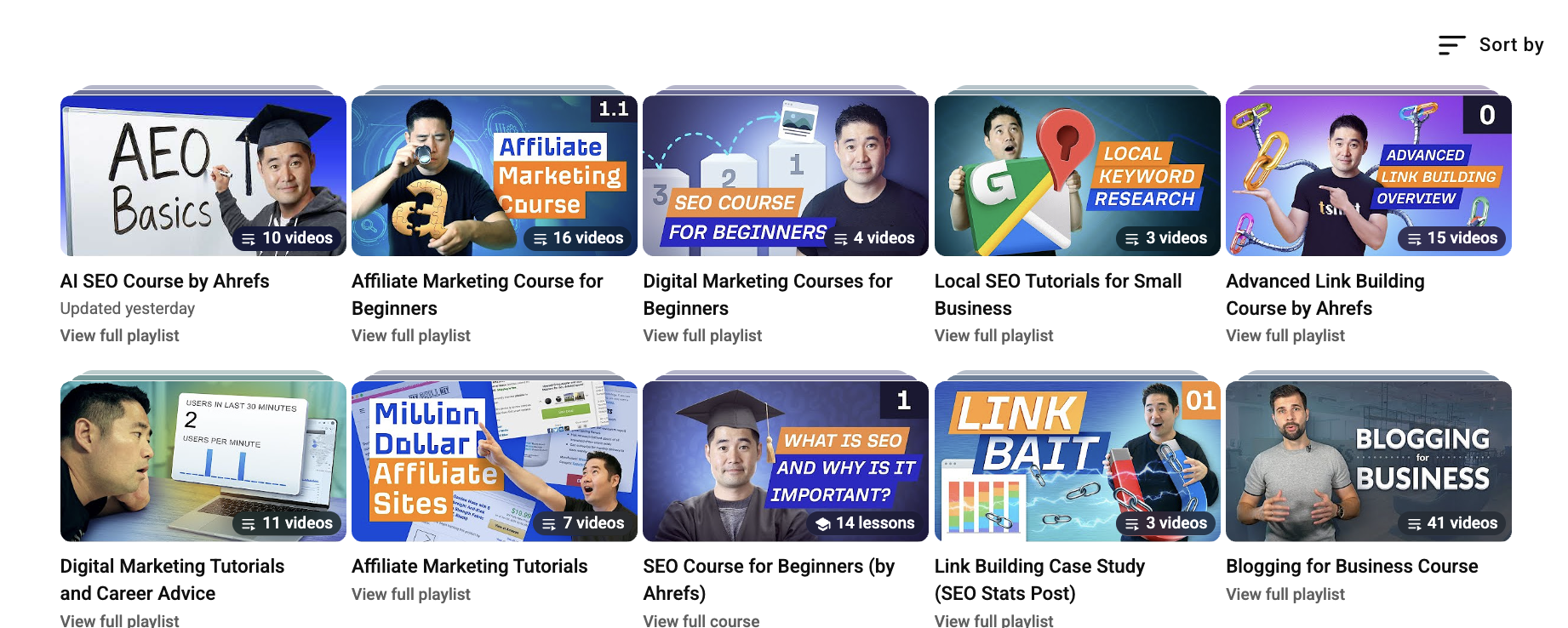
Ahrefs's playlist library: each one is a named course or tutorial track built around a search query and an audience, not an internal label.
The foundation tutorial track. Every getting-started video, every product walkthrough. Sequenced beginner to advanced. The Ahrefs "Course for Beginners" equivalent.
Every customer mini-doc lives here. Real people, real results, on camera. Customer name first, outcome second, brand third. Searchable by brand for buyers researching social proof.
The monthly product update series and any feature launch videos. Existing audience surface for current customers who want to stay current.
On-demand archive of every Braze-hosted webinar, cross-posted from Wistia. The library buyers and customers come back to between live sessions.
Every Forge keynote, breakout, and session recording. Chaptered. Pair with 20-40 Shorts cut from each event. Compounds year over year.
Two persona-segmented playlists, one for each side of the buyer team. Same videos can live in multiple playlists. Grammarly's persona matrix is the model.
A skill ladder above the existing Braze 101. Viewers self-select to depth. ActiveCampaign's Beginner-to-Advanced track is the proven version.
All AI decisioning content (explainers, demos, customer stories) clustered into one named track. Targets the AI search query directly, the way Ahrefs's "AEO Basics" playlist does.
Organized by what the marketer is trying to do, not by what product they're using. Buyers search by outcome.
Activation in the first 30 days. Welcome series, feature adoption nudges, the early-lifecycle playbook.
Bringing lapsed customers back. The campaigns that compound over a year, not a week.
Building the top-tier customer experience. Tier mechanics, perks, reward triggers.
Early-warning signals, save flows, win-back triggers. High-search topic across every B2C category.
One playlist per Braze surface. Each one is a search-anchor for the marketer searching by channel.
Setup, deliverability, copy, A/B testing, the full stack. "Push notifications" is a keyword Braze can own.
From sender reputation to dynamic content. The deliverability and design playbook for enterprise marketers.
The owned-app surfaces. Templates, triggers, and the design patterns that don't feel like interruptions.
Opt-in flows, compliance, copy that earns the second send. SMS is the channel marketers most often get wrong.
Anchored on the verticals where Braze already wins. Every buyer self-selects to their industry first.
Cart recovery, post-purchase, AOV-lift plays. Pair with the existing retail customer stories.
Loyalty mechanics, location-triggered offers, daypart campaigns. A vertical Braze is a clear leader in.
Subscriber acquisition, content-engagement nudges, free-to-paid conversion. Pair with the existing media customer stories.
Onboarding, compliance-aware messaging, deposit and engagement plays. High-stakes, high-value vertical.
POV content from Braze leaders. The brand-building side of the channel.
The flagship interview series, all in one playlist. Audio version distributed to Spotify and Apple Podcasts.
Forward-looking POV content from Braze leaders. Category-defining commentary that earns analyst attention.
Broader category education beyond decisioning. AI experimentation, agentic workflows, where the discipline is heading.
YouTube is the second-largest search engine and the #1-cited domain in Google AI Overviews. This audit scores title optimization, description depth, playlist structure, and closed-caption strategy across every direct competitor, plus the AEO signals now driving AI citation.
Every channel was scored 1-10 on each dimension by a Marketwake analyst against a rubric grounded in 2025-2026 YouTube SEO research (Backlinko, vidIQ, Tubics, Briggsby) plus a hand review of the trailing 30 days of uploads. Scores are expert judgments, not algorithmic. Ahrefs (the ICP Match) anchors the 9/10 ceiling because it hits every criterion across all four dimensions: keyword-first titles, transcript-style descriptions, tightly-clustered keyword playlists, and a consistent on-camera host on closed-caption-ready content.
9/10 example: Ahrefs, "How to Do Keyword Research" (keyword-first, exact-match search query).
2/10 example: Braze, "What's New? June 2025" (no searchable phrase).
Description length has the strongest statistical correlation with AI citation probability of any single signal (r = 0.31 per vidIQ 2025).
9/10: Ahrefs's keyword-research and SEO playlists are keyword-named and densely populated; Canva's "Design School" playlist mirrors the same discipline.
3/10: Braze has playlists, but most are event-named (Forge 2024) rather than keyword-named.
Weighted composite of the three dimensions above plus the closed-caption check from the dedicated section below the chart:
Title SEO carries the highest weight because it gates discovery on every other surface (search, browse, suggested, AI). The closed-caption component is graded against the criteria in the AEO section below: professional vs auto-captions, transcript publishing, and timestamp coverage.
Calibration: Two analysts scored each channel independently on the first pass; final scores reflect the consensus after a reconciliation review. Sample size per channel: full title and description audit on the trailing 30 days of uploads, plus a spot-check of the channel's top 10 all-time videos for pattern confirmation.
| Company | Title SEO | Description | Playlists | Overall | Key Issue |
|---|---|---|---|---|---|
Ahrefs (ICP Match) | 9/10 | 9/10 | 9/10 | 9/10 | The gold standard for B2B SaaS title and description discipline |
Salesforce (main) | 7/10 | 8/10 | 7/10 | 7/10 | Event titles weaker |
ActiveCampaign | 7/10 | 6/10 | 7/10 | 7/10 | Some brand-first titles |
Klaviyo | 7/10 | 6/10 | 7/10 | 7/10 | Ecommerce niche advantage |
Oracle | 6/10 | 7/10 | 5/10 | 6/10 | Channel fragmentation |
Hightouch | 5/10 | 5/10 | 7/10 | 5/10 | Practitioner titles, no awareness keywords |
Adobe for Business | 5/10 | 5/10 | 5/10 | 5/10 | Product naming inconsistent across channel |
Iterable | 3/10 | 3/10 | 5/10 | 3/10 | Webinar titles, not SEO (channel dormant) |
MoEngage | 2/10 | 3/10 | 4/10 | 3/10 | Conference talk titles |
Braze | 2/10 | 2/10 | 3/10 | 2/10 | Brand-first, no keywords |
Not all of Braze's titles are bad. Some hit the question-keyword pattern that wins in YouTube search. The problem is inconsistency: the channel mixes genuinely strong SEO titles with brand-only titles that have zero shot at organic discovery. Every title below is a real YouTube upload.
These titles use question-keyword formats, include searchable terms, and match how users actually search on YouTube. Braze should do more of this.
| YouTube Title | Why It Works |
|---|---|
| "What Is AI Decisioning? The Future of 1:1 Personalization" | "What Is [keyword]?" is a top-performing YouTube title format. Matches question-based search intent directly. "AI Decisioning" is a keyword Braze can own. The subtitle adds context without diluting the question. |
| "What is Braze?" | 40,767 views (their #1 video by far). The "What is [brand]?" format captures high-intent branded search. This is exactly what someone types when evaluating the platform. |
| "Reinforcement Learning for Marketers: How It Really Works" | Keyword-first ("Reinforcement Learning"), audience-specific ("for Marketers"), and the subtitle promises clarity ("How It Really Works"). Strong search + click-through combo. |
| "Why Next-Best-Action Fails at Scale" | "Why [concept] fails" is a proven contrarian hook that drives clicks. "Next-Best-Action" is a searchable industry keyword. The "at Scale" qualifier targets enterprise buyers specifically. |
| "Testing Push Notifications with Braze" | Action-oriented ("Testing"), includes both a feature keyword ("Push Notifications") and the brand. Someone searching "push notification testing" could find this. |
These titles are brand-only, internal-facing, or missing searchable keywords entirely. They will never appear in YouTube search results for anyone who isn't already looking for Braze.
| Current YouTube Title | Issue | Suggested Rewrite |
|---|---|---|
| "What's New? June 2025" | No keywords at all. "What's New" is internal language. Nobody searches "what's new June 2025" on YouTube. | "Customer Engagement Platform Updates: What's New in Braze (June 2025)" |
| "BrazeAI Decisioning Studio" | Product name only. No one outside Braze's existing users knows this product name exists yet. | "AI Decisioning Studio: Automate 1:1 Personalization with BrazeAI" |
| "Braze End Of Year 2025" | Internal event title. Zero organic search value. Reads like an internal company video. | "Customer Engagement Year in Review: Top Trends from 2025" |
| "Braze for Email Marketing" | Brand-first with a generic descriptor. "Email Marketing" is a strong keyword but "Braze for" pushes it behind the brand. | "Email Marketing Automation: How Braze Powers Cross-Channel Campaigns" |
| "Braze Cares Volunteer Week 2025" | Employer branding, not product content. Fine for culture but shouldn't be on the main product channel. | Consider separate channel or LinkedIn-only |
| "Inside Braze" | 10,618 views but purely brand-search traffic. Title has no keyword value beyond the brand name itself. | "Inside Braze: How the Customer Engagement Platform Works" |
These titles target the right keywords but the formatting hurts discoverability. The keyword strategy is sound; the execution needs adjusting.
| Current YouTube Title | What's Right | How to Improve |
|---|---|---|
| "See Braze in Action" | 10,152 views. "In Action" signals a demo, which is high-intent. | "Braze Product Demo: See Customer Engagement Automation in Action" |
| "AI decisioning & reinforcement learning explained" | Two strong keywords ("AI decisioning", "reinforcement learning") + "explained" is a great YouTube suffix. | "AI Decisioning & Reinforcement Learning Explained for Marketers" |
| "How Braze Powers AI-Driven Customer Engagement" | "How [brand] Powers [keyword]" is a solid branded-keyword format. "AI-Driven Customer Engagement" is searchable. | Already decent. Could add: "How Braze Powers AI-Driven Customer Engagement (2026 Demo)" |
Lead with the brand only when the viewer is already searching for it. Every other title should lead with the keyword, the problem, or the customer name. Use the matrix below on every upload.
| Viewer Intent | Lead With | Template & Example |
|---|---|---|
| Category awareness | Keyword | [Keyword]: [Benefit] ([Year]) · "Customer Engagement Platforms Explained (2026)" |
| Problem search | Keyword | Why [Problem] Fails · "Why Next-Best-Action Fails at Scale" (Braze already does this) |
| Solution comparison | Both | [Brand] vs [Brand]: [Angle] · "Braze vs Salesforce: Enterprise Lifecycle Marketing" |
| Branded evaluation | Brand | What Is [Brand]? · "What is Braze?" (40.7K views, their #1 video) |
| Product feature tutorial | Keyword + Brand | How to [Action] with [Product] · "How to Build a Multi-Channel Journey with Braze Canvas" |
| Customer story | Customer name | How [Customer] [Outcome] with [Brand] · "How Sportsbet Drove 40% Lift via Braze" |
High-CTR formats that match how marketers actually search YouTube and Google. Each one leads with a keyword or a number, not with "Braze." Pick the format that matches the video's job; fill the brackets with the real keyword.
| Format | Template | Example |
|---|---|---|
| Listicle | [Number] [Keyword] [Outcome] in [Year] | "7 Push Notification Strategies That Lift Retention in 2026" |
| Beginner guide | [Keyword] for Beginners: [Angle] | "Customer Engagement for Beginners: A 2026 Walkthrough" |
| Definition | What Is [Keyword]? (and Why It Matters) | "What Is a Customer Data Platform? (And Why It Matters for Lifecycle)" |
| How-to | How to [Action] [Keyword] in [Timeframe] | "How to Warm an IP Address in 30 Days (Without Killing Deliverability)" |
| Mistakes | [Number] [Keyword] Mistakes to Avoid | "5 Lifecycle Marketing Mistakes Killing Your Retention" |
| Versus / decision | [Keyword A] vs [Keyword B]: Which Wins for [Use Case] | "Push vs Email: Which Wins for Re-Engagement in 2026" |
| Framework | The [Name] Framework for [Keyword] | "The RFM Framework for Lifecycle Segmentation" |
| Result-driven | How [Customer] [Outcome] with [Tactic] | "How Sportsbet Cut Churn 22% with Predictive Send-Time" |
| Time-bound | [Keyword] Explained in [N] Minutes | "Canvas Flow Builder Explained in 6 Minutes" |
| Year-tagged guide | [Keyword]: The Complete [Year] Guide | "SMS Marketing: The Complete 2026 Guide" |
| Tactic + brand | [Tactic]: A [Brand] Playbook | "Predictive Send-Time: A Braze Playbook" |
| Industry-specific | [Keyword] for [Industry]: [Angle] | "Onboarding Flows for Fintech: Compliance + Conversion" |
| Question | Is [Keyword] Worth It in [Year]? | "Is Push Notification Marketing Worth It in 2026?" |
| Demo / walkthrough | [Product Feature] Demo: [Use Case] | "Braze Canvas Demo: Building a Cart-Abandon Journey" |
Closed captions used to be an accessibility nice-to-have. In 2026 they're the single most important AEO signal Braze can act on.
Why this matters for AEO: AI search engines don't watch video. They read transcripts, descriptions, captions, and timestamps. A video with clean professionally corrected captions is far easier for Google AI Overviews, Perplexity, and ChatGPT to cite than one with auto-captions full of punctuation errors. Google's John Mueller confirmed in 2020 that Google uses transcripts and captions to understand video. Multiple 2025 studies (vidIQ, Contently, OtterlyAI) show description length (r = 0.31) is the strongest single correlate of AI citation, beating subscriber count and views.
Upload professionally corrected SRT or VTT. Never publish with auto-captions. Post the transcript as a LinkedIn article and a blog embed.
300+ words. Crawlable summary in the lead paragraph. Keyword-loaded chapter timestamps. FAQ block. Links to related Braze resources.
3+ chapters on every video over 5 minutes. First chapter at 0:00. Chapter titles follow keyword-first naming.
JSON-LD on every braze.com embed: contentUrl, thumbnailUrl, description, uploadDate, duration. Add SeekToAction for Key Moments.
Six ways to stretch every Braze upload past the YouTube algorithm, plus a bonus on free platform-native levers.
Each upload could find multiple homes. Embed it in the matching blog post. Send it in the next Braze newsletter. Surface it in-app and in help docs. Hand it to sales as a follow-up asset (Gong, Chorus, and Outreach all accept video links). One asset, many surfaces, zero net-new production.
The lift: pages with embedded video hold sessions 2.6x longer and produce 41% more qualified leads (SeoProfy).
On YouTube. TrueView in-stream against competitor and category search terms. Shorts ads to reach younger B2B buyers in the vertical feed. CTV placements for enterprise ABM accounts watching on the living-room screen.
Off YouTube. LinkedIn Thought Leader Ads to Braze's ICP first. Meta retargeting with cut-downs second. Programmatic CTV through Demandbase or a similar ABM platform for high-value accounts. X and Reddit only when the topic genuinely fits the audience.
The math: Thought Leader Ads pull 1.7x CTR at 62% lower CPC than standard LinkedIn ads. TrueView runs $0.05-$0.10 CPV for B2B software (charged only after 30 seconds). CTV completes 30-second spots at 96% for $20-$25 CPM.
One long-form video should fund a multi-week social calendar. Three to five LinkedIn-native clips (60-90 sec, uploaded directly), 8-12 vertical Shorts/Reels/TikToks, a few quote graphics, one audiogram for the podcast crowd, and a LinkedIn Newsletter post. Drop the YouTube link in the first comment, not the post body.
The rule: LinkedIn native video earns 5x the engagement of external-link posts.
Sponsor 3-5 lifecycle marketing or MarTech YouTubers (5K-50K subs) to feature Braze in their tutorials. Stand up an employee-advocacy program (GaggleAMP, EveryoneSocial) so every Brazer with LinkedIn becomes a distribution node.
The number: employee shares pull 8x the engagement of brand-owned posts.
Add VideoObject schema (JSON-LD) to every video embed on braze.com so the page can surface with Key Moments in Google. Embed YouTube in the blog posts that already rank page one. Republish transcripts as blog content so Google AI Overviews, Perplexity, and ChatGPT can cite them.
Why now: YouTube drives 38.1% of all social citations in AI search answers.
Every upload ships through a Braze-sent email. GIF thumbnail with a play-button overlay (Outlook can't render inline video). The word "video" in the subject line. Weekly cadence over monthly. The first distribution step for any new upload is a Braze campaign. The playbook is also the demo.
The lifts: "video" in the subject line raises opens 19% and CTR 65%. A visible play button on the thumbnail lifts positive response 40.83% (Wistia).
The platform ships with free amplification tools most B2B brands ignore. Schedule every long-form as a Premiere so the upload reads as a live moment (chat appears, the fresh-content signal fires harder). Run a thumbnail A/B test on every video (built into Studio, costs nothing). Use end screens and cards to push viewers into the next video in the playlist, since session watch time is the metric the algorithm rewards most. Pin a comment with the question the video answers.
YouTube isn't a brand channel anymore. It's a creator economy. Viewers subscribe to people, not logos. The B2B channel that wins (Ahrefs) runs with one recurring host who becomes the face of the brand on the platform. Braze has to do the same: treat the channel like a creator would run it, not like another corporate distribution surface.
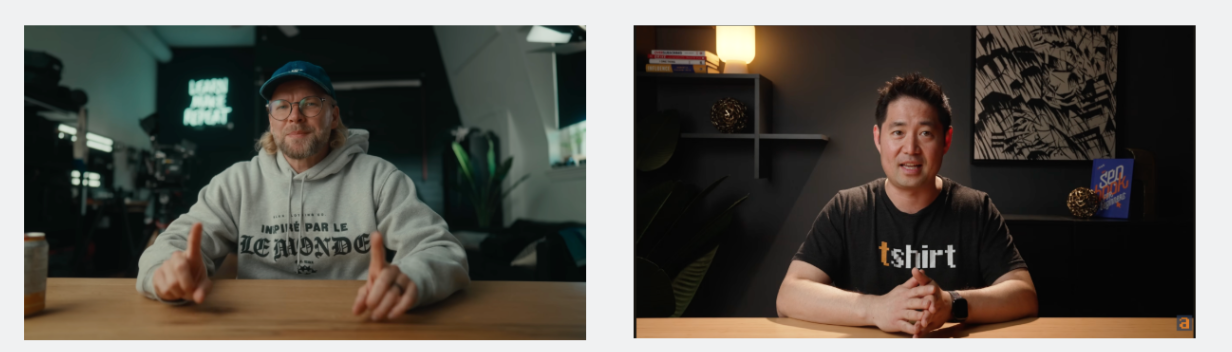
Pick 1-3 hosts. Same intro, same setup, same energy. Product shots and screens cut in as B-roll. The host is the throughline; the product is the proof. Parasocial recognition compounds: a viewer who knows the host clicks faster, watches longer, and subscribes for the host as much as the topic. A logo can't do that work. Every channel ahead of Braze in this cohort figured this out years ago.
One host, consistent setup, B-roll cut in for the screens. The viewer stays anchored to a face; the product still gets all the airtime. Now run that same setup every week for a year and watch what happens to subs.
The internal production standard the Braze team is using when anyone steps in front of the camera. Shared here so every host, customer, and exec contributor is filming to the same spec.

Reference frames: mid-torso to above head, eye-level camera, clean intentional background, host front and center. This is the shot to copy.
When the camera isn't a dedicated rig (quick takes, customer self-shoots, exec walk-and-talks), use these device-specific rules to keep the look consistent with the main filming guide above.
Ahrefs (664K subs, 1,795 subs per video, highest efficiency in the audit) built its channel on Sam Oh as the recurring host. HubSpot's Marketing Against the Grain did the same with Kipp Bodnar and Kieran Flanagan. Subscribers come back for people, not brands. Braze has no recurring faces today. Every video is fronted by a different employee or nobody at all.
Pick a small bench of recurring hosts before any new production starts. Two minimum, three or four ideal, one per series.
Picking the hosts is the highest-leverage decision in this whole playbook. Without consistent faces, none of the cadence or series work compounds.
Where to start. Six plays, zero or near-zero production cost. The housekeeping moves that let everything else compound: clean up the existing library, source new topics from assets that already exist, lock a cadence to ship them.
Rewrite the non-keyword-focused titles across the library (the strong, keyword-led titles can stay as-is). Keyword-first, brand-second on every rewrite. Descriptions to 300+ words with chapter timestamps and an FAQ block. Description length is the strongest single predictor of AI citation (r=0.31, OtterlyAI). Targets a 2-3x lift on existing-library discovery and a step-change in AI citation surface inside 60 days.
Embed YouTube in the top 25 braze.com blog posts (2.6x longer sessions, 41% more qualified leads per SeoProfy; 3-5x more YouTube subs/month than cold discovery). Every YouTube upload ships through a Braze Canvas with a GIF thumbnail and play-button overlay (70.1% page-view rate from email thumbnails per Wistia; subject lines with "video" lift opens +19% and CTR +65%). Reuses existing assets.
Rule of thumb: every new video added to braze.com gets chapter markers and JSON-LD VideoObject schema (with SeekToAction) at the same time the embed goes live. Chaptered videos get cited multiple times per AI response (78% of cited videos), versus once for non-chaptered, and the schema unlocks Key Moments in Google Search. Marketwake already runs the SEO program, so this is a process to standardize, not a backlog to build from scratch.
The blog already covers the topics that perform on YouTube: deep linking, IP warming, push primer, AI agent use cases, comparison content. Each post is structurally ready to become a video. The post topic is the video title, sections become chapters, use-case lists become Shorts. One blog post = 1 long-form + 6 Shorts = 7 pieces of content, with near-zero net-new ideation. Three worked examples in the Blog → Video pipeline section →. Pair this with Rec 01 (titles) and you've got an SEO-ready video supply for the year.
Thumbnails are the single biggest lever on click-through rate, and Braze's current ones leave most of it untouched. Build a small set of templates (one per series, one for one-offs) so every upload is fast to produce and instantly recognizable.
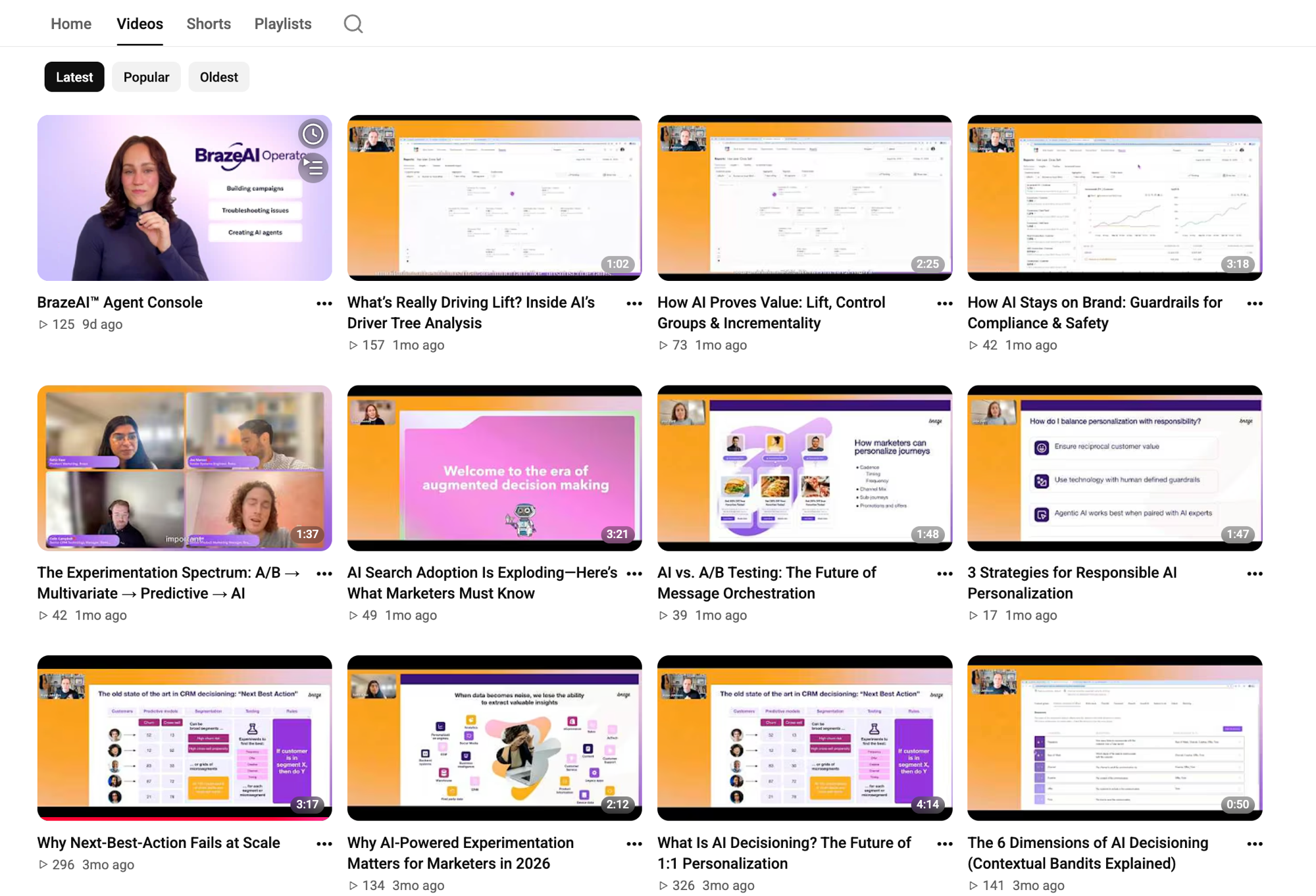
Current state — Braze:
![]()
Lots of UI screenshots, small webcams, low-contrast title bars. Hard to read in a feed.
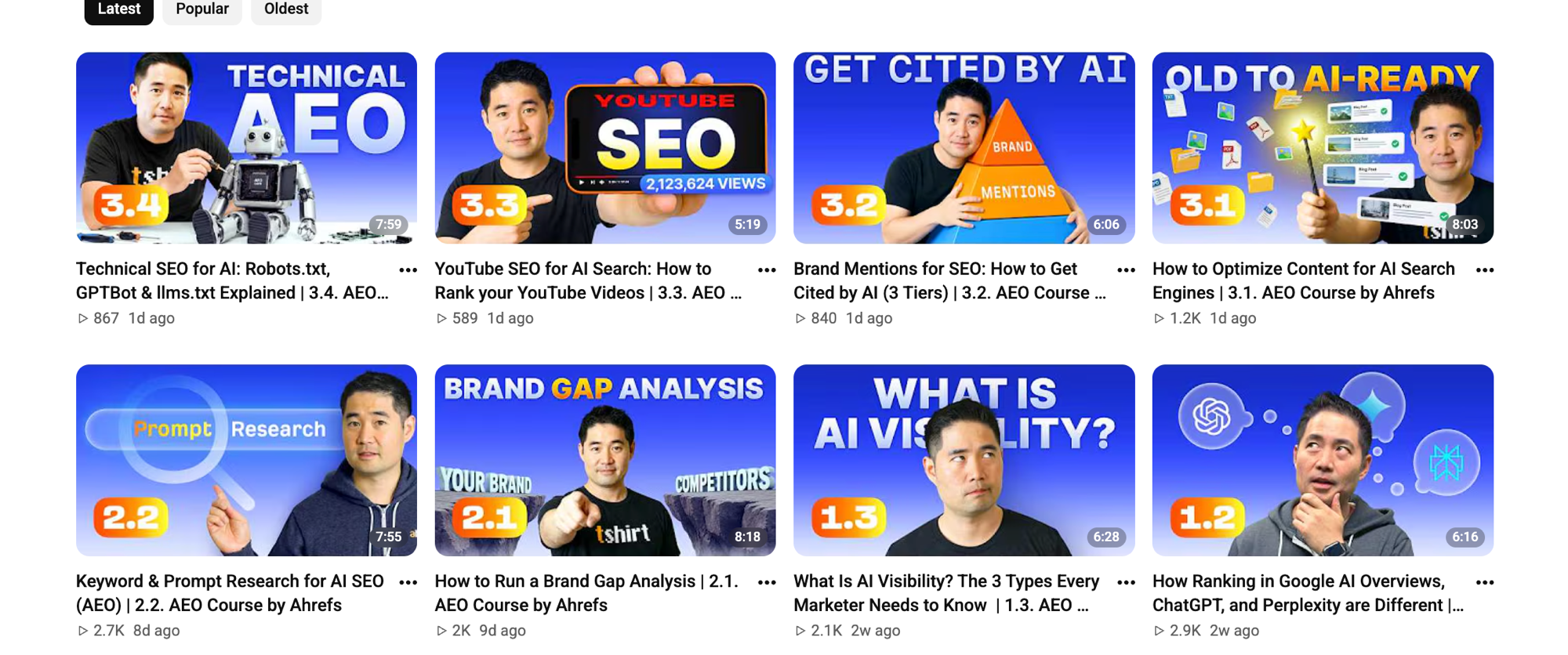
What good looks like — Ahrefs:
![]()
Big bold text (2-3 words max), saturated background colors, host face front and center, clear episode numbering. Designed to be read at thumbnail scale.
The thumbnail rules:
YouTube needs ~90 days and 12-15 paced uploads to profile a channel. Batch-drops break that. Pick 1-3 recurring series from the Topic Ideas section below (we'd start with "Lifecycle Decoded" or "Built with Braze"), shoot for one video per week, and ship episode one this week. Consistent publishers see +67% subs, +89% retention, +156% watch time, +234% recommendations (Onewrk 2025).
What to build toward. Foundation cleans up what's there. Strategic Bets are what builds something new. Three bigger plays for Q3-Q4, each one unlocking subscriber growth or category share that Foundation can't reach on its own.
Every active competitor has a flagship with a recognizable face. Braze has none. Biweekly 25-min interviews fronted by a Braze exec or marketing leader (the CMO is the obvious option, but a VP of Lifecycle, a Head of Brand, or a recurring partner host can carry the format) with newsletter and podcast distribution. Builds the parasocial relationship a brand-only channel can't. HubSpot's series cleared 7,000 dedicated subs and 300K views before spinning out.
The current product walkthroughs lean on UI screenshots and floating webcams. Rebuild the demo/product format around a consistent host, a clear narrative arc, and tighter pacing. Each video should feel like a piece of media first, a tutorial second. Pulls double duty: a sharper demo library for sales enablement and a cleaner top-of-funnel watch on YouTube.
Shorts is the algorithm play. Long-form requires a viewer to search, click, and commit; Shorts gets pushed to viewers who never searched for Braze in the first place. That's how a B2B channel reaches a new audience without paying for it. Three plays to run in parallel:
The point: a Shorts cadence puts Braze in the For You feed of marketers who weren't looking. Long-form converts the ones who were.
What comes after. Plays that need the channel to be on a steady cadence first. Each one extends reach into a new format or audience once the foundation is holding.
Every B2B SaaS that wins on YouTube hits the same tipping point: outside creators start making tutorials about the product on their own. Salesforce, Notion, HubSpot, Figma all crossed it. Braze isn't there yet. Pay 10-15 marketing and MarTech YouTubers (5K-50K subs) to build tutorial tracks on Braze. Layer a "Braze Certified Creator" tier on top with perks like early feature access and Forge passes.
What this looks like in the wild:
Two paths to the same outcome. Path A — the full podcast: distribute the flagship interview series (CMO Hour or whichever series lands) as audio on Spotify and Apple Podcasts. Reaches the commute and gym slots YouTube can't, expands top-of-funnel for the same production cost, and gives sales a second-screen asset to share with execs who won't watch a 25-min video. Path B — clip-farm like a podcast even without one: shoot every flagship interview podcast-style (two cameras, mics, framed for both wide and close-up cuts), then chop each episode into 8-12 vertical clips with hook-first openings ("here's why your push CTRs are dropping"). That's the format every podcast on the For You feed runs — the long-form barely exists outside the clips. Even without the Spotify side, the YouTube channel gets a steady stream of high-engagement Shorts from every long-form shoot.
Once the first 1-3 series are locked and the channel is on a steady cadence, layer in additional formats from the Topic Ideas section. Vertical-led shows, customer story series, Shorts spinoffs of the long-form library. Adds variety without breaking the cadence of the established series, and gives the algorithm more surface area to recommend Braze content from.
One trend worth building into the editorial calendar from day one.
Auto-captions sit at 68-78% accuracy. Every misheard product term, executive name, and customer name gets indexed as the canonical transcript, which is exactly what AI search engines pull from when they cite a video. Clean SRT or VTT files fix that in one move.
The lift: professional captions raise search traffic 180-520% (SendShort, US Captioning) and give Google AI Overviews, Perplexity, and ChatGPT a transcript they can quote without garbling the words. Captions also raise watch time, which is what the YouTube algorithm rewards most.
The math: roughly $3 per minute. About $2,500 total for the first 20 videos. One of the lowest-effort, highest-leverage moves in the entire report.
The menu of what to make. Six recurring series concepts and ten specific videos to ship this quarter. Pick what you'd actually want to make. The recommendations above are how we start shipping them.
Standalone videos burn the team out. Series compound. Pick two to ship in parallel: one weekly, low-cost (Tutorial or Talking Head) plus one biweekly, higher-production (CMO Spotlight or Shorts series).
One Braze product marketer breaks down a lifecycle marketing concept in 8-10 min. Same set, same intro, same end-card. One concept per episode. Reference: Ahrefs/Sam Oh.
Braze CMO interviews customer CMOs and lifecycle marketing leaders. 25-min long-form. Newsletter and podcast distribution. Reference: HubSpot's Marketing Against the Grain.
3-4 min talking-head case study per customer. A real person (CSM or customer marketer) walking through the results on camera, with light supporting visuals only. Customer name first, outcome second, brand third. Reference: Klaviyo's Beyond Black Friday.
10-episode mockumentary Shorts following a fictional brand team. Same characters return weekly. The format borrows from B2C serialized comedy (Duolingo's "Living with Lily") and applies it to lifecycle marketing.
10-15 min talking-head with a strong contrarian POV per episode. Braze's "Why Next-Best-Action Fails at Scale" already proves the format works.
Specific titles with format and target length. Concrete examples to film against the series above.
Keyword-first, brand-second, year-tagged. Targets the buyer who already knows Braze and wants to see Canvas before a demo call.
"Push Notifications" is a search keyword Braze can own. The contrarian "top 5 mistakes" hook drives CTR.
"Why X fails" is Braze's strongest existing format. AI personalization is a high-search topic in 2026.
Customer-name-first, outcome second, brand last. Re-edit the existing Wistia version with a real person walking through the results on camera as the lead, designed assets as support. The Sportsbet operator or a Braze CSM works.
No equivalent comparison video exists from Salesforce or any other competitor. Pair with a /vs/salesforce landing page.
Braze CMO interviewing a customer CMO. Episode 1 of the flagship series. Audio version distributed to Spotify and Apple Podcasts.
Mockumentary Short opener. Fictional brand team, real campaign scenario. Same character returns weekly.
Recut the existing long-form into a 45-second vertical Short with captions. Reuses an existing asset. Test the format for Braze.
Upload within 48 hours. Chapter markers per session. AEO-optimized description with full speaker list and timestamps. Pair with 20-40 Shorts cut from the keynote.
Category-defining content. Targets a generic high-volume keyword no direct competitor owns on YouTube. Animated explainer in Braze brand style.
Braze's blog already covers the topics that perform on YouTube. Each post has a topic (video title), sections (chapters), and use cases (Shorts). One blog post becomes seven pieces of content with near-zero net-new ideation.
braze.com/resources/articles/ip-warming
"How to Warm Up an IP Without Tanking Deliverability"
braze.com/resources/articles/whats-deep-linking
"What is Deep Linking? A Marketer's Guide"
A partial inventory of existing Braze posts that fit the pattern, paired with a suggested YouTube title for each. The blog title is the keyword target, so the YouTube title keeps the same question or how-to structure rather than reframing it. Viewers search YouTube the way they search Google: typing the question. Keep the question, win the impression.
| Existing blog post | Suggested YouTube title |
|---|---|
| What is AI decisioning in marketing? | "What Is AI Decisioning in Marketing? (Explained in 5 Minutes)" |
| How to use AI decisioning to choose the best customer action | "How to Use AI Decisioning to Choose the Best Customer Action" |
| How to use AI decisioning to improve personalization and targeting | "How to Use AI Decisioning to Improve Personalization and Targeting" |
| How to use AI decisioning to optimize customer engagement | "How to Use AI Decisioning to Optimize Customer Engagement" |
| How to implement AI decisioning in a marketing strategy | "How to Implement AI Decisioning in a Marketing Strategy" |
| Best examples of AI decisioning use cases in marketing | "The Best AI Decisioning Use Cases in Marketing" |
| Best AI decisioning platforms | "What to Consider When Choosing the Best AI Decisioning Platforms" |
| Best AI decisioning platforms for marketing | "What to Consider When Choosing the Best AI Decisioning Platforms for Marketing" |
| Best AI decisioning platforms for customer engagement | "What to Consider When Choosing the Best AI Decisioning Platforms for Customer Engagement" |
| What is AI experimentation and how does it differ from traditional marketing experimentation? | "What Is AI Experimentation and How Does It Differ From Traditional Marketing Experimentation?" |
| How is personalization used in retail to increase conversion and average order value? | "How Is Personalization Used in Retail to Increase Conversion and AOV?" |
| How is reinforcement learning used in marketing and personalization systems? | "How Is Reinforcement Learning Used in Marketing and Personalization?" |
| What are the best SMS marketing platforms? | "What to Consider When Choosing the Best SMS Marketing Platforms" |
| What are the best email marketing platforms? | "What to Consider When Choosing the Best Email Marketing Platforms in 2026" |
| What are the best mobile marketing platforms? | "What to Consider When Choosing the Best Mobile Marketing Platforms in 2026" |
| How to decide when to replace or consolidate tools in your martech stack | "How to Decide When to Replace or Consolidate Tools in Your Martech Stack" |
| What is a customer engagement platform? | "What Is a Customer Engagement Platform?" |
| What are the best cross channel marketing platforms? | "What to Consider When Choosing the Best Cross-Channel Marketing Platforms" |
| What are the best omnichannel marketing platforms? | "What to Consider When Choosing the Best Omnichannel Marketing Platforms" |
| What are the best journey orchestration platforms? | "What to Consider When Choosing the Best Journey Orchestration Platforms" |
Performance benchmarks and 2026 trends, B2B and B2C. Reference data, collapsed by default. Click to expand.
Every data point in this audit is sourced. Citations grouped by category. Metrics confirmed April 23-24, 2026.
Direct URLs observed to verify each amplification surface claim during the original competitor scan. YouTube channel-level metrics rely on third-party trackers (vidIQ, Tubics, SocialCounts) because YouTube channel pages render client-side and are not directly parseable.